
The latest Giving USA report offers encouraging news: charitable giving in the U.S. reached an estimated $617.2 billion in 2025, crossing the $600 billion mark for the first time.
That headline is worth celebrating. But for nonprofit leaders and boards, the more important question is: What does this mean for long-term financial resilience?
The answer is nuanced. Giving is growing — but not evenly, not predictably, and not always in ways that support day-to-day operations.
For organizations with endowments, this environment may reinforce the value of having a long-term financial base.
For organizations without endowments, the data may be a reminder that now is the time to consider whether an endowment, quasi-endowment, or other long-term reserve strategy should be part of the financial plan.
The headline: giving is up, but the sources are shifting
Giving USA reported that individual giving remained the largest source of charitable dollars in 2025, totaling an estimated $394.2 billion, or 64% of total giving. But that share has continued to decline, according to Candid’s summary of the report.
At the same time, other sources of giving are playing a larger role. Foundation giving reached $117.15 billion, corporate giving totaled $43.67 billion, and bequest giving rose sharply to $62.19 billion, representing 10% of total giving, according to Candid.
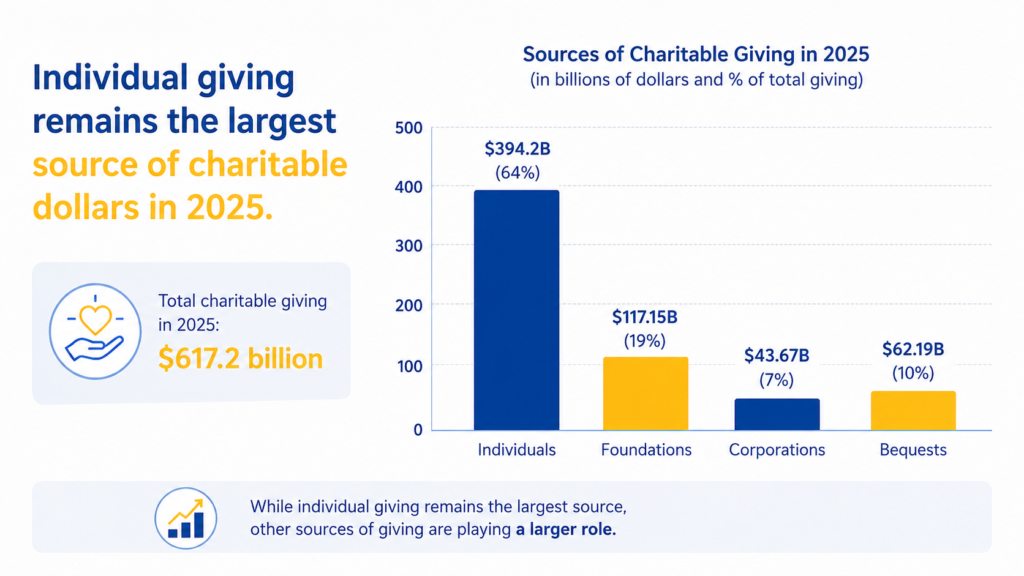
For nonprofits, this matters because the donor landscape is becoming more concentrated, more asset-driven, and potentially more uneven. A strong year for giving does not necessarily mean every organization feels more financially secure.
Bequests may be the most important signal for endowment planning
One of the most notable findings from the latest Giving USA report is the surge in bequest giving, even though bequest giving can fluctuate significantly from year to year. This could be an early sign of what’s being called the Great Wealth Transfer, in which one generation is expected to transfer a tremendous amount of wealth to their heirs or to charity. For nonprofits, this has important implications. Bequests are often unrestricted or broadly designated, and they can create opportunities to build long-term financial strength — if an organization is prepared to receive and steward them well. That preparation includes:
- A clear gift acceptance policy
- Board-approved endowment or reserve policies
- A spending policy that defines how much can be used annually
- Investment policies aligned with the organization’s purpose, risk tolerance, and time horizon
- Donor communication that explains how legacy gifts can support the organization’s future
In other words, the growth in bequest giving is not just a fundraising story. It is a governance and investment policy story, too.
What this means for nonprofits with endowments
For nonprofits that already have endowments, the Giving USA data reinforces the strategic value of long-term capital.
An endowment can help smooth the impact of year-to-year fundraising volatility. While annual giving may rise or fall with the economy, donor sentiment, public policy, or market conditions, an endowment can provide a more predictable source of support through a disciplined spending policy.
That doesn’t mean endowments eliminate risk. Endowments are invested, and investment returns can fluctuate. But when managed thoughtfully, they can help nonprofits:
- Support annual operations with predictable distribution
- Fund strategic priorities beyond the annual budget cycle
- Preserve donor intent across generations
- Signal institutional stability to donors, funders, and lenders
- Create a natural home for planned gifts and legacy gifts
This is especially relevant in a giving environment that appears increasingly tied to asset values. CNBC quoted Jon Bergdoll, lead analyst for the Giving USA report and interim director of data and research partnerships at the Indiana University Lilly Family School of Philanthropy, saying there is “always a pretty tight connection between bequest and overall net worth,” which is also connected to the market.
That connection is important for endowment committees and boards. If future giving is increasingly linked to wealth, estates, appreciated assets, and sophisticated giving vehicles, nonprofits need the policies and financial infrastructure to receive those gifts effectively.
What this means for nonprofits without endowments
For nonprofits without endowments, the Giving USA report is not necessarily proof that every organization should immediately launch one. But it is strong evidence that boards should have a serious conversation about long-term capital.
Organizations without endowments may be more exposed to annual fundraising swings, delayed donor decisions, changes in government funding, or shifts in foundation priorities. Even in a year when total giving reached a record high, the benefits may not be evenly distributed. This year, “mega-gifts” — like the ones given by MacKenzie Scott — supported a relatively small number of organizations. But those don’t change the day-to-day financial reality for many community-based organizations.
Endowments are not a substitute for annual fundraising
One caution: even though we support nonprofits building an endowment, those should not be treated as a replacement for annual giving.
An endowment can strengthen an organization’s financial foundation, but it usually supports only a portion of the budget. A typical spending policy may distribute a modest percentage of the endowment’s average market value each year, often designed to balance current support with long-term preservation.
That means nonprofits still need strong annual fundraising, donor engagement, and grant strategy. The Giving USA data shows that individual giving remains the largest source of philanthropy, even as its share of total giving has declined. An endowment strategy should complement — not compete with — annual fundraising.
For donors, that distinction should be clear. Annual gifts help meet today’s needs. Endowment gifts help ensure the organization can continue meeting needs in the future.
The board conversation: readiness, policy, and purpose
For boards, the Giving USA report offers an opportunity to move the endowment conversation from the abstract to the practical.
A useful board discussion might include:
Do we have a long-term capital strategy?
If the organization receives a significant bequest tomorrow, would the board know how much to spend, how much to invest, and how to communicate that decision?
Are our investment and spending policies current?
An endowment is only as strong as the policies that govern it. Investment policy, spending policy, liquidity needs, and risk tolerance should all be reviewed regularly.
Are we prepared for planned gifts?
With bequests growing sharply, nonprofits should make it easy for donors to include the organization in their estate plans and understand how legacy gifts will be used.
Are we balancing today’s needs with tomorrow’s stability?
Some organizations hesitate to build endowments because current needs are urgent. That concern is real. But long-term reserves and endowments can be designed to support mission continuity rather than restrict it.
Are we communicating the “why”?
Donors and board members are more likely to support an endowment when they understand its purpose: sustaining the mission, protecting programs, and serving future generations.
How Fairlight Advisors can help
At Fairlight Advisors, we help nonprofit leaders and boards connect investment strategy with mission strategy. That includes helping organizations evaluate whether an endowment or long-term reserve is appropriate, develop investment and spending policies, review governance practices, and communicate clearly with stakeholders about the role of long-term funds.
The Giving USA data is a timely reminder: philanthropy is changing, and nonprofits that prepare now will be better positioned to receive, steward, and sustain generosity for the future.
Reach out to learn more.

Fairlight Advisors
Latest posts by Fairlight Advisors (see all)
- Market & Economic Snapshot Q3 2026 - October 9, 2026