Nonprofit leaders are no strangers to uncertainty. They navigate fluctuating funding cycles, shifting community needs, evolving regulations, and unpredictable economic environments. Yet when you have an endowment or board fund — or are considering launching one — one question seems to resurface with renewed urgency in every moment of market turbulence:
“Is now a good time for our nonprofit to invest?”
This concern is especially common right now, as organizations face heightened volatility around funding sources, mixed messages from the Federal Reserve and government, and persistent chatter about interest rates and inflation. With so many external forces at play, many boards and executive directors understandably worry about locking up funds or making the wrong move.
But here’s the truth—one echoed consistently by seasoned advisors:
Now is always the right time to invest.
This doesn’t mean being reckless or ignoring risk. It means understanding that waiting for clarity is far riskier than entering the market during periods of uncertainty. Time — not timing — is what builds financial resilience for mission-driven organizations.
The Myth of the Perfect Moment
As we like to say: “The right time to invest is always.” Waiting for stability is tempting, but markets are never really predictable. The feeling of impending risk is not a sign to pause; it’s simply part of the investing experience.
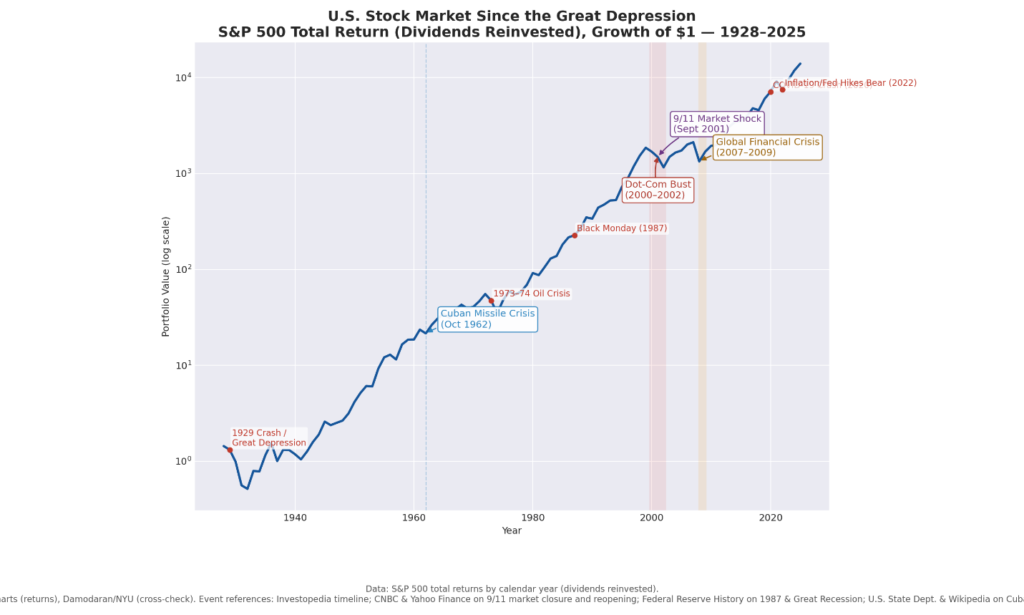
Every downturn in history has appeared frightening in real time. Yet when viewed on a long-term chart, the downturns shrink into small dips while the upward marches of growth stretch far longer.
For nonprofits with multi-year or perpetual missions, those long stretches matter much more than short-term discomfort.
It’s like the adage that the best time to plant a tree was 20 years ago. The second-best time is today. It’s the same with investing.
What Long-Term Really Means for Nonprofits
When it comes to investing, one of the biggest misconceptions nonprofit boards have is around what “long-term” means. Many assume investing requires a 20-year runway, as if they were managing a university endowment. But in reality, even 3-5 years can be considered a long enough horizon for investment growth.
If your organization is saving for:
- a future property
- a new program
- a strategic reserve
- or a board-designated fund meant to outlast current leadership
then time is already on your side.
Even short- to intermediate-term goals can support thoughtful investment strategies. Board members and nonprofit professionals don’t need to be experienced equity investors. But they do need to understand — especially with the help of an advisor — the balance between potential growth and potential volatility.
The key question is not “Are we comfortable with risk?”
It’s “Are we comfortable losing purchasing power by not investing?”
The Real Risk Isn’t the Market — It’s Inaction
Nonprofit leaders often view investing as risky, but another risk quietly eroding their ability to fulfill their mission is inflation.
Cash sitting in a bank account feels safe and familiar. But that safety is an illusion. Every year, inflation eats away at the value of that cash. Meanwhile, the organization’s costs — staffing, rent, supplies, utilities, program delivery — continue to climb.
So the choice isn’t between “risk” and “no risk.”
It’s between market volatility and guaranteed loss of buying power.
Investing is the only reliable tool nonprofits have to preserve and grow the value of their dollars over time.
Short-Term Needs vs. Long-Term Stewardship
How to invest available funds depends on when and how the funds will be used. Short-term operating reserves and long-term mission capital require different investment approaches.
- Operating reserves: Given their purpose, they’re best kept in short-term investments such as high-quality short-duration bonds or Treasury bills. Rates remain relatively attractive on the short end of the curve, and organizations benefit from liquidity.
- Longer-term funds: Money meant to serve the mission beyond the next 2–3 years belongs, at least in part, in growth-oriented investments — including equities. That’s the only way assets can really grow to serve your mission better.
Nonprofits don’t have to choose one or the other. They can use layered investment strategies that balance immediate stability with long-term sustainability.
The Federal Reserve, Treasuries, and What Really Matters
We could talk forever about pressure on the Federal Reserve, political influence, interest rates, and global alternatives like Canadian or Australian money markets. And there is plenty of commentary in the media doing that. These are important considerations, but for nonprofits, they don’t change the fundamental truth:
U.S. Treasury securities remain among the safest investments in the world.
Even with political noise, high national debt, or speculation about future tax policies, the U.S. maintains an unmatched financial infrastructure and borrowing capacity. While nonprofits may hear about teaser rates or high-yield offerings from banks, those often come with hidden risks or short-term limitations.
The broader takeaway is this:
Trying to outsmart investment markets is not a productive use of nonprofit resources.
Focus instead on time horizon, liquidity needs and risk tolerance.
Nonprofits Don’t Need to Navigate This Alone
Let us reassure nonprofit leaders: you aren’t expected to be investment experts. In fact, most board members are not.
If your organization is unsure about:
- how to structure a portfolio,
- the risks of equities and other asset classes (metals, crypto),
- how long-term the mission truly is,
- or how to protect funds in this economic environment,
the solution is not to wait.
The solution is to ask an advisor. Don’t wing it or don’t do nothing. Organizations don’t need to choose between paralysis and rash optimism. They can choose an informed strategy.
Time Is the Mission’s Most Valuable Asset
When nonprofit leaders ask, “Is now a good time to invest?” they’re usually asking a deeper question: “Will we be putting our mission at risk?”
But the mission is at far greater risk when nonprofits have assets to invest but delay.
Time is the only force that consistently converts short-term volatility into long-term growth. Time is what turns dips into recoveries. Time is what magnifies returns through compounding.
And time is what nonprofits have — often more than they realize.
Whether your organization is saving for next year or building for the next generation, the most important step is simply to begin. Not during the next economic calm, not after the next election, not when inflation settles.
Now. Always now.
Because the mission can’t wait.
And neither should the resources that fuel it.
👉 If your organization is unsure how to begin, or you’d like a clear, mission-aligned strategy for investing in any market environment, we’re here to help.
Send us a message or reach out at support@fairlightadvisors.com, and let’s build a plan that strengthens your mission for years to come.

Fairlight Advisors
Latest posts by Fairlight Advisors (see all)
- Why Big Donors May Hesitate to Fund an Endowment From Scratch - September 10, 2026