
Let’s say you binge watch a number of alarming food documentaries one day and decide to explore a brand new diet that could change your life for the better. You’ve always wanted to adopt a healthier lifestyle. It starts well: you’re motivated and better yet, lose weight quickly! But keeping it up proves harder as time goes on. The dishes aren’t as satisfying as your old diet. You’re forced to cook more, which isn’t always convenient for you and keeping up your diet at restaurants is a royal pain. Some supposedly acceptable foods seem to be more on the spectrum of junk food than healthy food. After some time on this diet, you’re glad you started but now realize how much effort it takes to understand and maintain.
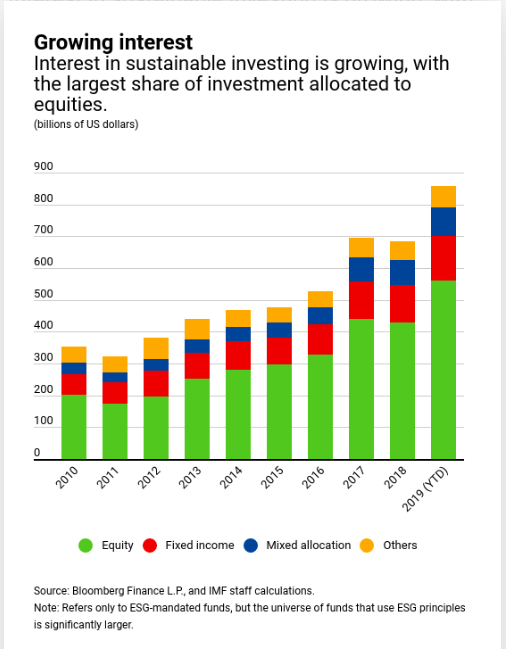
Growth in ESG Assets
Source: Bloomberg Finance and IMF
While this is a simplistic example, it’s similar to what small to midsize nonprofit investors face when delving into the world of ESG (Environmental, Social and Governance) investing. ESG investing seeks positive returns through investing in businesses that deliver long-term benefits to society and the environment. The demand for this type of purpose-driven investing is certainly a positive, as it puts further pressure on companies not only to deliver financial performance, but also to treat their employees, the environment and their communities more ethically. The demand for ESG is borne out by the numbers. Bloomberg Finance and the IMF report that ESG funds today control approximately $850 billion in assets, a nearly 150 percent increase from 2010.
Philanthropic investors, such as nonprofit endowments, foundations and major donors have shown more interest in ESG as it’s become easier to align investments to a particular mission. IRS notice 2016-62 has given endowments more flexibility in selecting mission-related investments as long as the organization exercises due care in evaluating investment options. But small to midsize nonprofit endowments that want to explore ESG often don’t have the resources to properly vet this investment strategy. If executed improperly, some ESG investments could be perceived as a breach of the board’s fiduciary duty. As with any new investment, investors should take caution before taking the plunge, so below we’ve provided a high-level summary of the potential hurdles one should be aware of with respect to ESG investing.
1. Not All “ESG” is Created Equal – Do Your Homework
As with any investment, one should understand the basic terminology. ESG, Socially—Responsible, Green, Impact—the terms abound! Sonya Dreizler, a Bay Area consultant specializing in ESG, SRI, and Impact investing, states on her website, “Almost every conference or panel discussion about impact or sustainable investing starts with a discussion of terminology.” While the terms are used interchangeably, they mean different things and Dreizler strongly recommends investors be familiar with the differences. See her introduction to ESG and Impact investing and other helpful guides here.
Another complication is how “ESG-ness” is assessed. Fund managers that offer ESG products rely on dozens of third-party ratings agencies dominated by four major players: MSCI, Sustainalytics, RepRisk, and ISS. According to the study “Ratings that Don’t Rate: The Subjective World of ESG Ratings Agencies” by Tim Doyle for the American Council for Capital Formation, ratings vary widely between agencies and sometimes standards are not transparent. Doyle found inherent biases in the results of the ratings, due to company size, geography and industry.
With so many definitions and approaches, philanthropic institutions should be aware of the limitations and biases of ESG investing and do the necessary homework when coming up with an investment strategy.
2. There’s a Cost to Being Responsible – Understand the Potential Financial Tradeoffs
ESG has become big business. Opimas, a global consultancy, predicts the cost of buying ESG data will rise 50% to about $750 million in 2020. As investors demand more sophisticated ESG strategies, fund managers demand more data to implement those strategies. And that data comes with a price. Fund managers today are passing some of those costs onto investors, which ultimately eat into the return a fund might deliver. The financial haircut an investment might take to invest in ESG in one year may seem insignificant, but over time, costs can range in the thousands and potentially millions, depending on the account size. It’s one thing to sacrifice return for “good” in an up market, but when markets are lagging, investors may not be so enthusiastic.
Nonprofit investors need to understand the potential financial tradeoffs that come with investing in ESG and how underperformance due to cost might be communicated to major donors.
3. ESG Has a Short Track Record – Proceed with Care
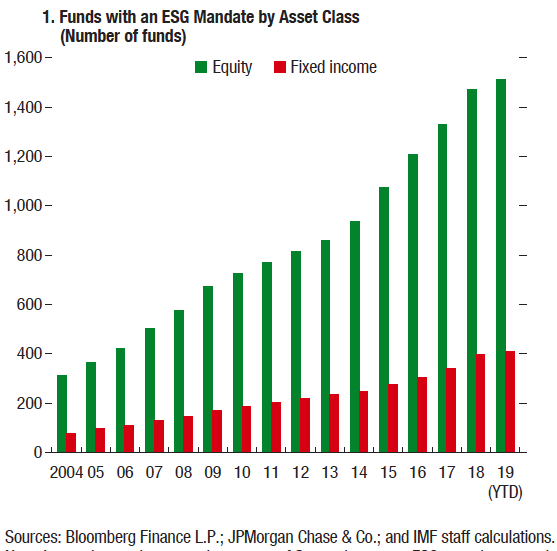
The IMF’s October 2019 Global Financial Stability Report stated that ESG funds provided returns comparable to conventional funds, contradicting research that suggest ESG investors must sacrifice performance. This news comes with a big caveat: ESG investing doesn’t have a long track record. According to the IMF report, the number of funds with an ESG mandate are closing in on 2,000, with nearly half of those funds launched within the last 8 years. That’s almost 1,000 funds with less than a 10-year track record.
Nonprofits expect endowment investment returns to meet very specific spending needs. It becomes harder to gauge whether required returns will be achieved if endowment portfolios use predominantly new ESG funds which are untested in a variety of market conditions.
The demand for ESG investments is an overall positive for the economy. As Dreizler notes, “Focusing corporations, investment firms, and investors on how companies can be better actors in their communities will usher in positive change.” As with any investment, do your homework, know the costs and proceed with care before diving into ESG.
All written content is for information purposes only. Opinions expressed herein are solely those of Fairlight, unless otherwise specifically cited. Material presented is believed to be from reliable sources and no representations are made by our firm as to other parties’ informational accuracy or completeness. All information or ideas provided should be discussed in detail with an advisor, accountant or legal counsel prior to implementation.
Like What You’ve Read?
Sign up with your email address to receive news and updates.
We respect your privacy.
Talk to the financial experts at Fairlight Advisors to learn more about managing your nonprofit’s investments. Schedule a free consultation today!

Fairlight Advisors
Latest posts by Fairlight Advisors (see all)
- Market & Economic Snapshot Q1 2026 - April 29, 2026