
Why Board Financial Leadership Matters More Than Ever
Many nonprofit board members assume their role is to review financial statements and approve budgets. Those responsibilities are important, but they’re not enough.
Strong missions require strong finances. And strong finances require boards that actively shape financial resilience, not just monitor it.
The difference shows up in how organizations respond to uncertainty: funding shifts, delayed grants, or unexpected demand. The most effective boards don’t just react — they plan for these moments in advance.
The Mindset Shift: From Oversight to Stewardship
Here’s the critical shift:
Reactive mindset:
“We’ll use reserves or the endowment if we need to.”
Resilient mindset:
“We intentionally deploy our financial resources to strengthen the organization’s future.”
This means viewing financial assets — especially board-advised funds and endowments — not just as safety nets, but as strategic tools for growth, stability, innovation and mission impact.
In practice, we often see organizations fall into a reactive pattern — tapping reserves or board funds whenever there’s a shortfall.
But the most resilient organizations ask a different question:
“How can we use these resources to generate future capacity and revenue?”
Best Practice #1: Separate and Define Financial “Buckets”
One of the most common governance gaps is the blending of financial resources that should be kept distinct.
Boards should ensure clear separation between:
- Operating reserves (short-term stability)
- Board-advised funds (strategic growth and innovation)
- Endowment funds (long-term sustainability)
Why it matters:
- Operating reserves are for unexpected disruptions
- Board-advised funds should be used for intentional, strategic investments
- Endowments support long-term mission continuity
When these roles blur, organizations risk using long-term assets to solve short-term problems — undermining stability.
Boards should also ensure that funds are **“ring-fenced”** (clearly separated in the spending policy), not simply part of a pooled bank balance.
Best Practice #2: Use Financial Assets Strategically
A powerful but underused strategy: deploying funds to strengthen fundraising and infrastructure.
For example, instead of covering a shortfall:
- Invest in a development role or campaign
- Fund capacity-building systems or staff
- Support diversification of revenue streams
Why this works:
- Spending $100,000 on programs delivers $100,000 of impact
- Spending $100,000 on fundraising or infrastructure can generate multiples of that over time
This is a shift from filling gaps to creating growth.
Best Practice #3: Require a Plan to Replenish Funds
Discipline is what turns flexibility into resilience.
If an organization draws from a board-advised fund or endowment:
- There should be a clear plan to replenish it
- The board should understand how and when it will be restored
- Replenishment can be built into budgets or future fundraising
Some organizations formalize this in their investment or reserve policies, ensuring that significant withdrawals are paired with a repayment strategy.
A helpful framing:
Treat internal funds like a loan to the organization itself — used thoughtfully, and paid back with intention within a specific period of time.
Best Practice #4: Focus on Liquidity and Cash Flow (Not Just the Budget)
A balanced budget does not guarantee financial health.
Nonprofits often face timing gaps that boards must monitor, such as delayed grants or reimbursement-based contracts.
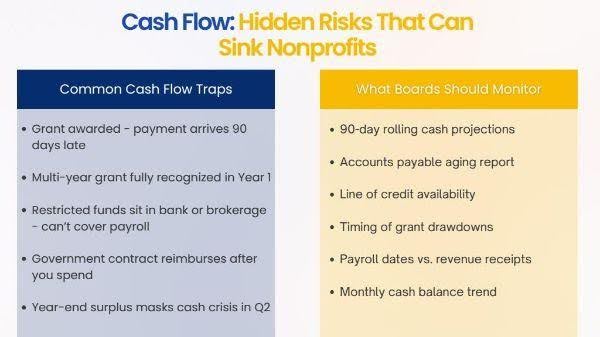
As highlighted above, risks include:
- Revenue recognized before cash arrives
- Restricted funds that can’t be used for operations
- Payroll obligations that don’t align with funding timing
Boards should regularly ask:
- Do we have enough cash available, not just revenue booked?
- How many months of reserves are truly liquid?
- Are we projecting cash flow 90 days ahead?
Financial resilience depends on understanding when money arrives — not just if it exists.
Best Practice #5: Use the Budget as a Governance Tool
Budgets are not just financial documents. They are strategic commitments.
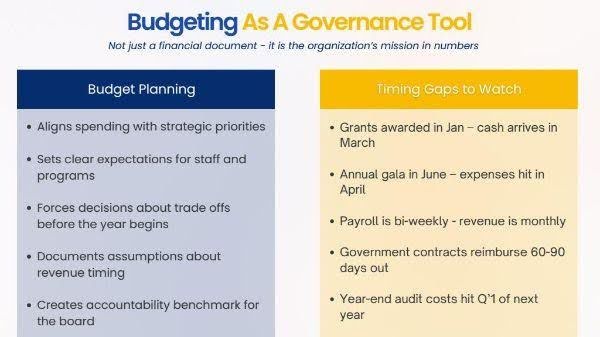
A strong board uses the budget to:
- Align spending with priorities
- Make trade-offs before the year begins
- Set accountability benchmarks
- Clarify assumptions about revenue timing
This shifts budgeting from a compliance exercise to a governance tool that drives decision-making.
Best Practice #6: Strengthen Oversight Through Structure
Effective governance requires clear roles and strong internal controls.
Boards should:
- Approve budgets, policies, and audits
- Monitor financial trends over time
- Ask informed, strategic questions
Staff should:
- Manage day-to-day transactions
- Execute the budget
- Maintain financial systems
Strong internal controls, like separation of duties and independent review, protect both the organization and its people.
The goal is not more oversight — it’s better oversight.
Best Practice #7: Think in 5–15 Year Time Horizons
Many nonprofits plan year to year. Resilient organizations plan much further out.
Boards should regularly ask:
- Where do we want to be in 5, 10, or 15 years?
- How should our endowment strategy support that vision?
- Are we investing today in future capacity?
Without this long-term perspective, even well-funded organizations can make short-term decisions that erode sustainability.
Final Takeaway: Discipline Drives Mission Impact
Nonprofit financial resilience isn’t about having the most money. It’s about how intentionally and strategically that money is governed.
Boards that:
- Separate and define financial resources
- Plan for both risk and opportunity
- Use assets to create future capacity
- Maintain discipline through policies and oversight
…position their organizations to thrive, not just survive.
At Fairlight Advisors, we work with nonprofit leaders and boards to build financial strategies that align resources with mission — today and for the long term.
Want to strengthen your organization’s financial resilience?
Connect with us here: https://www.fairlightadvisors.com/contact.

Fairlight Advisors
Latest posts by Fairlight Advisors (see all)
- Market & Economic Snapshot Q3 2026 - October 9, 2026