
For many nonprofit organizations, having an endowment or board-advised fund is viewed as a marker of financial strength. It signals foresight, stability, and responsible stewardship. But in practice, Fairlight Advisors often sees something very different: board funds quietly being used as operating reserves, eroding long-term financial resilience instead of strengthening it.
We’ve looked a lot at how endowments and board-advised funds should fit into a nonprofit’s financial ecosystem — and why misusing them can undermine even well-intentioned organizations.
Financial Strength Is About Discipline, Not Just Dollars
An important distinction is that money alone does not create financial strength. Discipline does.
An organization can have a healthy board fund and still lack strong financial hygiene if it hasn’t clearly defined:
- the purpose of that fund,
- how it differs from operating reserves, and
- when (and how) it may be used.
Without these guardrails, board funds often become a convenient fallback for short-term financial stress — masking underlying structural problems rather than solving them.
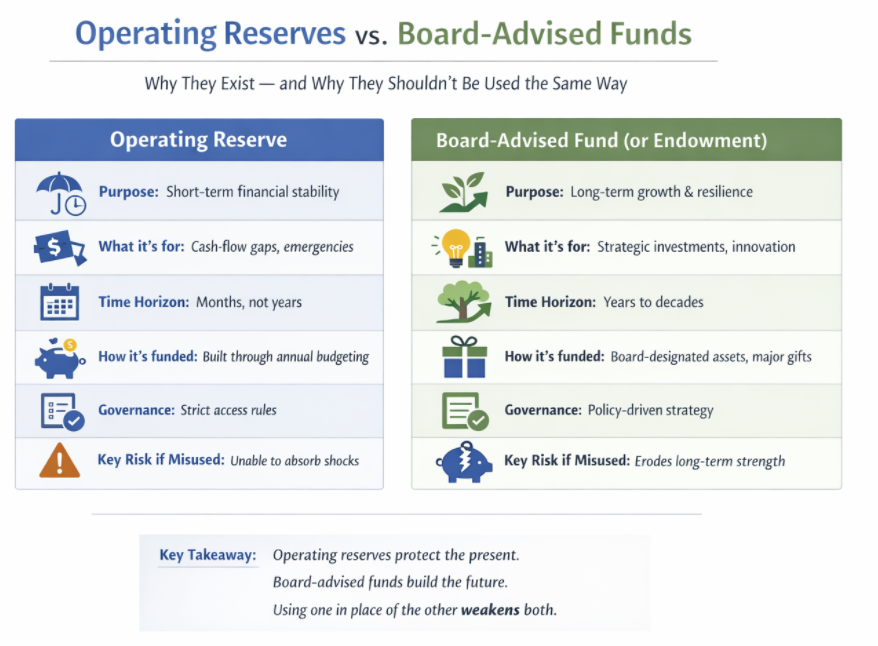
Many nonprofits unintentionally treat board-advised funds and operating reserves as interchangeable. They are not. And confusing the two is one of the fastest ways to weaken long-term financial resilience.
The Core Risk: Using Board Funds to Plug Gaps
Across the nonprofit sector, Fairlight regularly sees board funds tapped to cover:
- fundraising shortfalls,
- delayed or canceled grants,
- program overruns, or
- routine operating deficits.
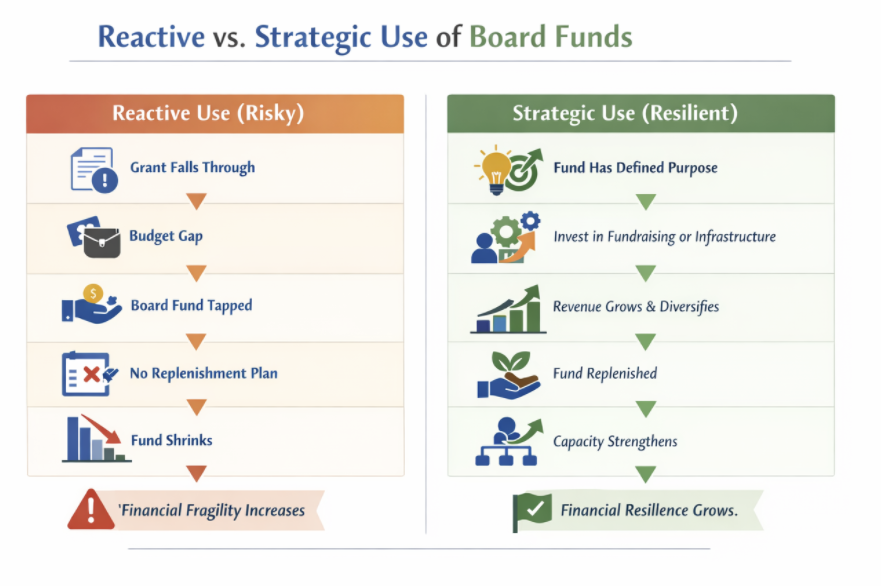
In true emergencies, this may be necessary. But when this becomes a pattern — and especially when there is no replenishment plan — the organization slowly drains one of its most strategic assets.
Using board funds reactively is about survival.
Using them strategically is about sustainability and growth.
Organizations that rely on board funds to “stop the bleeding” may survive the present moment — but often at the expense of sustaining their mission over the long term.
Reframing Board-Advised Funds as Strategic Capital
A more resilient approach is to treat board-advised funds as intentional investment capital, not emergency cash.
We encourage clients and partners to think of board funds similar to responsible debt. Not credit used to cover routine expenses — but capital deployed intentionally with a clear expectation of return.
For nonprofits, that return might include:
- strengthening fundraising infrastructure,
- hiring or supporting development staff,
- launching an endowment or capital campaign, or
- investing in systems that diversify revenue streams.
As Fairlight’s leadership often emphasizes, the goal isn’t to spend the fund — it’s to use it to build capacity that replenishes and grows the organization over time.
Build Flexibility into Policy — Before a Crisis Hits
Another recurring theme was the importance of well-designed investment policy statements.
Many nonprofits overly restrict their board funds, limiting use to such a narrow set of circumstances that when flexibility is truly needed — for infrastructure, staffing, or fundraising investment — the board must approve exceptions under pressure.
That’s not good governance.
The strongest organizations define expectations in advance:
- What is this board fund for?
- What types of investment are appropriate?
- What approvals are required?
- How will withdrawals be replenished?
Having these conversations early enables informed, timely decision-making when conditions change.
Why Board Funds Can Create a False Sense of Security
A particularly risky pattern arises when boards assume that having a board fund automatically means the organization is financially strong.
A $1 million organization with a $9 million board fund is not the same as a $10 million organization. Without financial discipline, spending can accelerate faster than revenue — leading to long-term instability despite apparent wealth.
Cash does not fix weak systems. In some cases, it magnifies them.
A Practical Mindset Shift for Nonprofit Leaders and Boards
Ultimately, the takeaway is about intentionality.
Operating reserves exist to protect against short-term disruption.
Board-advised funds exist to build long-term capacity.
When nonprofits conflate the two, they trade resilience for convenience.
By aligning board funds with a clear strategy, disciplined governance, and purposeful reinvestment, nonprofits can shift from reactive decision-making to sustainable, mission-driven growth.
At Fairlight Advisors, we believe nonprofit financial resilience isn’t about having more money — it’s about making better decisions with the money you have. Helping boards and leadership teams clarify the role of reserves, endowments, and board-advised funds is a critical step toward building organizations that can withstand uncertainty and thrive for the long term.

Fairlight Advisors
Latest posts by Fairlight Advisors (see all)
- Market & Economic Snapshot Q3 2026 - October 9, 2026